Land clearing is the process of removing trees, wild bushes, heavy brush, rocks, and old tree stumps from a piece of property. Property owners clear land when they want to build a new house, clear a path for a driveway, or remove dry brush to protect their home from wildfires. Understanding the total cost helps you plan your project budget and choose the right clearing equipment.
In California, land clearing costs between $1.18 and $2.00 per square foot, or $1,200 to $5,600 per acre on average for standard building lots. Clearing light brush using forestry mulching starts at $400 to $2,500 per acre, while clearing steep hillsides with heavy trees and stumps costs $3,500 to $8,000+ per acre.
What Is the Average Cost Per Acre for Land Clearing Methods in California?
Land clearing costs depend heavily on the method you choose. Forestry mulching is the most affordable option ($400 to $2,500 per acre) because it grinds brush into mulch on-site. Bulldozer clearing costs $1,500 to $4,500 per acre, while heavy timber removal with stump pulling costs $3,500 to $8,000+ per acre.
| Land Clearing Method | Cost Per Acre Range | Cost Per Sq. Ft. Range | Best Application / Main Benefit |
| Forestry Mulching | $400 to $2,500 | $0.01 to $0.06 | Light brush and small trees; leaves mulch on the ground. |
| Traditional Bulldozer Clearing | $1,500 to $4,500 | $0.03 to $0.10 | Complete tree and root extraction for home foundations. |
| Heavy Timber & Tree Removal | $3,500 to $8,000+ | $0.08 to $0.18+ | Dense pine forests with big stumps that must be pulled. |
| Goat Grazing (Brush Mowing) | $600 to $1,800 | $0.01 to $0.04 | Clearing steep brush on hillsides without heavy machines. |
Forestry mulching saves money because it uses one machine with a high-speed rotor to grind bushes and small saplings into fine mulch. The operator spreads the fresh mulch across your property. This means you do not have to pay dump fees to haul green waste away. However, if you plan to pour a concrete slab for a home, you must hire a bulldozer crew to pull tree roots out of the dirt.
How Much Does It Cost to Clear 1 Acre of Land in California?
Clearing 1 acre of land in California costs between $1,500 and $6,000 for a typical residential building lot. The total price combines five core expenses: brush mowing ($400 to $2,500), tree and stump removal ($500 to $1,500), green waste hauling ($400 to $1,200), city permits ($300 to $1,500), and soil erosion control ($400 to $1,500).
When you prepare a 1-acre property for building, your contractor completes several distinct tasks. Here is a clear breakdown of the five main costs that make up your total bill:
- Brush Mowing and Forestry Mulching: Heavy mulching machines shred thick brush and bushes into ground cover.
- Tree Felling and Stump Pulling: Cutting large trees costs $150 to $1,200 per tree. Extracting the root ball with an excavator adds $100 to $300 per stump.
- Debris Hauling and Dumpster Fees: Landfills in California charge $90 to $180 per ton for green waste disposal.
- Rough Grading and Dirt Leveling: Skid steers and motor graders smooth the dirt to create a level building pad.
- Soil Erosion Control: Installing straw wattles and grass seed stops rain from washing bare dirt into storm drains.
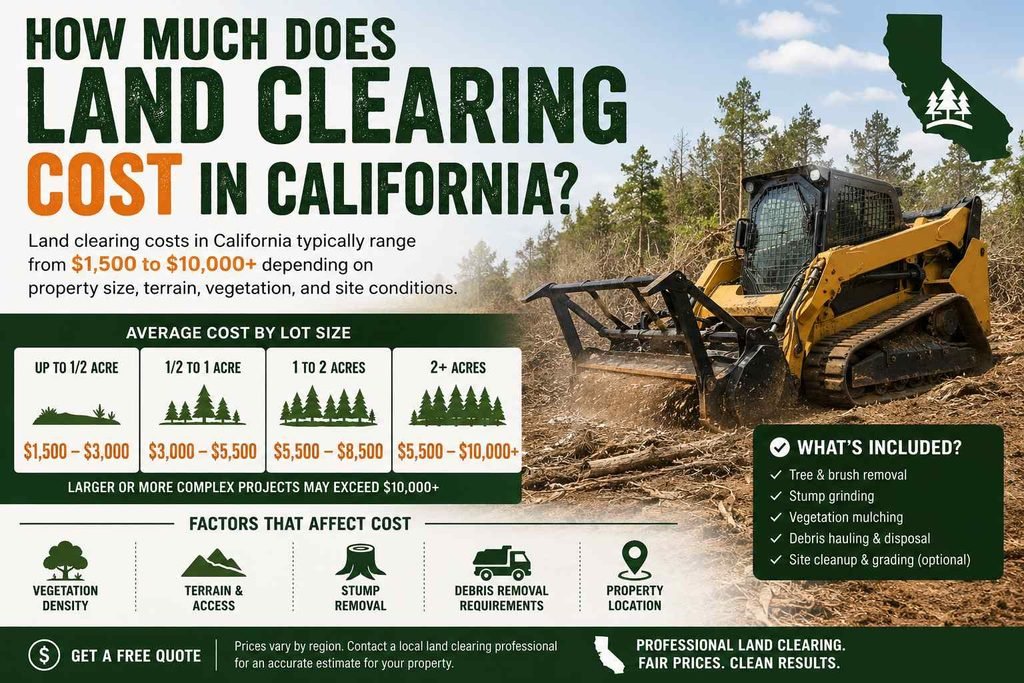
What Factors Increase the Cost of Land Clearing in California?
Six key items make land clearing more expensive in California:
- Steep Slopes and Hillsides: Slopes greater than 15 percent require specialized machinery and add 30 to 60 percent to labor costs.
- Large Mature Trees: Trees over 24 inches in trunk diameter require cranes and logging trucks.
- Protected Native Oak Trees: Local tree laws require arborist reports and city permit fees ($300 to $1,500).
- Rocky Ground and Boulders: Granite outcroppings require rock hammers and slow down equipment.
- Environmental Reviews: Checking land for nesting birds and wetland stream buffers.
- Hauling Distance to Recycling Sites: Long driving distances to green waste facilities increase fuel bills.
Slope and Hillside Terrain
Flat land is easy to clear because operators can drive excavators and mulchers at full speed. However, if your property is on a steep hillside, heavy machines move slowly to avoid tipping over. In some steep areas, workers must clear brush using handheld weed trimmers or goat herds. This extra labor time raises overall project costs.
Protected Native Oak Tree Ordinances
Many California cities and counties have strict laws protecting native trees like Coast Live Oak and Valley Oak. You cannot cut down a protected oak tree without an official permit. City inspectors usually require a report from a certified arborist before approving tree removal. Cutting down a protected oak tree without a permit can trigger fines of $1,000 to $10,000 per tree.
What Permits Are Required to Clear Land in California?
California requires four main administrative and environmental permits before clearing land:
- Check Local Tree Ordinances: Secure city permits before cutting native Oak, Redwood, or Heritage trees.
- Apply for a County Grading Permit: Required when moving 50 or more cubic yards of dirt or clearing over 10,000 square feet.
- Complete Environmental Bird Surveys: Conduct nesting bird inspections if clearing land between February 1 and August 31.
- Obtain CAL FIRE Defensible Space Approval: Follow state fire codes when clearing brush near buildings.
You must check with your local city or county planning department before bringing heavy equipment onto your land. Inspectors ensure your clearing work does not damage protected trees or cause mudslides.
If your project involves moving more than 50 cubic yards of soil, you must apply for a County Grading Permit. Also, state environmental laws protect nesting birds. If you clear brush during spring or summer, a biologist must inspect the property to verify no active nests are present. Once the biologist signs off, your contractor can begin work safely.
How Do Land Clearing Costs Vary by Region in California?
Land clearing costs vary across California based on regional labor rates, tree density, and local environmental rules. The San Francisco Bay Area is the most expensive ($2,500 to $7,500 per acre), while flat land in the Central Valley costs the least ($800 to $3,000 per acre).
| California Region | Price Per Acre Range | Average Half-Acre Lot Clear | Regional Drivers & Terrain |
| San Francisco Bay Area | $2,500 to $7,500 | $2,000 to $5,000 | Strict heritage tree laws, steep coastal hills, high labor rates. |
| Los Angeles & Southern CA | $2,000 to $6,500 | $1,800 to $4,500 | High fire hazard severity zones, strict hillside grading rules. |
| Northern CA & Sierra Foothills | $1,200 to $5,000 | $1,200 to $3,800 | Dense pine forests, steep ground, CAL FIRE defensible space rules. |
| Central Valley (Flat Land) | $800 to $3,000 | $800 to $2,200 | Flat agricultural land, open access, lower labor rates. |
San Francisco Bay Area
Land clearing in Bay Area counties like Santa Clara, San Mateo, and Marin carries higher prices. Local cities enforce strict tree preservation ordinances that require arborist inspections. Also, steep coastal hills make equipment transport more challenging.
Los Angeles and Southern California
Southern California properties often sit in designated High Fire Hazard Severity Zones. Local fire departments enforce strict clearing timelines to prevent wildfire spread. Also, hillside properties in Los Angeles County require specialized engineering reports for earth grading.
Northern California and Sierra Foothills
Properties in counties like Nevada, Placer, and Shasta feature dense evergreen forests. Clearing land here involves cutting mature pine and fir trees, which requires heavy logging equipment and stump grinders.
How Do CAL FIRE Defensible Space Rules Affect Land Clearing Costs?
Under California Public Resources Code (PRC 4291), property owners in High Fire Hazard Severity Zones must clear fire fuel within 100 feet of buildings. Creating this defensible space costs $800 to $3,000 per acre and requires trimming low tree branches, clearing dry brush, and maintaining a non-combustible 5-foot Zone Zero buffer around home walls.
California state law requires homeowners living in wildland areas to maintain defensible space around structures. This clearance gives firefighters a safe area to defend your home during a wildfire.
Defensible space clearing involves three main zones:
- Zone 0 (0 to 5 feet from buildings): You must remove all combustible materials, including dry leaves, wooden mulch, and bushes touching house walls.
- Zone 1 (5 to 30 feet from buildings): You must trim tree branches up to 6 feet from the ground and space out bushes so fire cannot jump between plants.
- Zone 2 (30 to 100 feet from buildings): You must mow annual grass down to 4 inches high and remove dead vegetation.
Because state inspectors check properties every summer, maintaining defensible space is an ongoing cost for California rural homeowners.
How Can Landowners Lower the Cost of Land Clearing in California?
Save money on California land clearing with these five practical strategies:
- Choose Forestry Mulching Over Excavation: Avoid debris hauling fees ($90 to $180 per ton) by grinding brush into mulch left on-site.
- Sell Commercial Timber: Offset clearing costs by selling valuable mature pine or fir logs to local sawmills.
- Clear Land Outside Nesting Season: Schedule clearing between September 1 and January 31 to avoid biologist inspection holds.
- Use Goat Grazing for Steep Hillsides: Hire goat herds to clear brush on steep slopes where heavy machines cannot operate.
- Bundle Clearing with Dirt Grading: Combine brush removal, driveway clearing, and house pad grading into one contract.
Frequently Asked Questions About California Land Clearing
Burn permits are strictly regulated by CAL FIRE and local Air Pollution Control Districts. Open brush burning is banned in most urban areas and allowed only during designated burn days in winter months with a valid CAL FIRE permit.
Yes. Most California cities and counties have Protected Oak Tree Ordinances. Removing native oaks like Coast Live Oak or Valley Oak over 6 inches in diameter requires a municipal permit, arborist inspection, and potential replanting fees.
Using a modern forestry mulcher, clearing 1 acre of light brush takes 1 to 2 days. Heavily timbered acres requiring stump extraction and rough dirt grading take 3 to 5 days.
Traditional land clearing uses bulldozers to pull up all vegetation and haul it away to landfills. Forestry mulching uses a single machine to grind brush and small trees into fine organic mulch left on-site, eliminating dump fees and preventing soil erosion.